
Thursday: The Most Expensive Robe

Daily Lesson for Thursday 4th of June 2026
Nice clothing too often defines the rich by worldly standards. Some people say, “I dress this way to express who I am.” But in heaven, everything other than our relationships will fade away (Matthew 6:19-21, NKJV). Our personal identity should be wrapped up in Jesus and His perfect robe of righteousness.
Read the parable in Matthew 22:1-14 that Jesus told to explain this. What messages can you find in this parable?
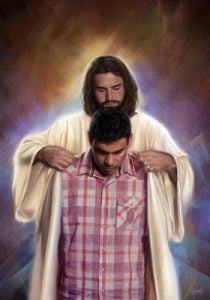
Image © Phl McKay Goodsalt.com
Jesus called the man without a robe “friend,” and despite his lack of response, they must have had a relationship. The man must have known about the robe but had chosen not to wear it. Jesus’ character is perfect and spotless, and He offers it to us that His church “should be arrayed in fine linen, clean and white” (Revelation 19:8), “not having spot, or wrinkle, or any such thing” (Ephesians 5:27).
The white linen “is the righteousness of Christ, His own unblemished character, that through faith is imparted to all who receive Him as their personal Saviour.”—Ellen G. White, Christ’s Object Lessons, p. 310.
Adam and Eve wore a white robe of soft light before they sinned; after they sinned, they realized they were naked (Genesis 3:7) and made clothing of fig leaves. Then God replaced their fig leaves with clothing made of animal skins. There was a sacrifice that produced their garment. In a similar way, we accept Jesus’ sacrifice by accepting His robe of righteousness. “Naked and ashamed, they tried to supply the place of the heavenly garments by sewing together fig leaves for covering. . . . Nothing can man devise to supply the place of his lost robe of innocence. No fig-leaf garment, no worldly citizen dress, can be worn by those who sit down with Christ and angels at the marriage supper of the Lamb. Only the covering which Christ Himself has provided can make us meet to appear in God’s presence. This covering, the robe of His own righteousness, Christ will put upon every repenting, believing soul.”—Ellen G. White, Christ’s Object Lessons, p. 311.
|
Reflect: We should daily choose to be clothed with Jesus’ robe of righteousness. What does this really mean, and how do we do this? |

Matthew 11:28 has long been misinterpreted by many as Jesus saying, “Come as you are…” In an actual sense, ask many Christians today, including Seventh-day Adventists, and there will be many who think this phrase is really in the Bible. Further, a friend recently argued that “Come as you are” could be the literal interpretation of Romans 5:8. Okay, what if they were both right? Does that mean we remain as we are or stay as we were?
Well, somewhere within the story of the garment lies the answer to the question of accepting a call, but on our own terms. Our terms, which Isaiah 64:6 refers to as “filthy rags.” The problem with the guest was not accepting the call; it was not about “coming as he was.” Rather, it was about protecting what, in his own terms, was his image and his ways. We have no idea whether he represented the good or the bad (Matthew 22:10), but we are sure that he did not don the garment provided by the King.
Maybe that’s the danger we should be aware of: getting on board, but selectively. Repentance may be the first thing—acceptance—but slowly, step by step, we should allow Christ to transform us. We should accept and settle within Christ’s garment.
In a world that constantly emphasizes fashion, appearance, and social status, clothing often becomes more than a means of covering ourselves—it becomes a reflection of how we see ourselves and how we want others to see us. At times, our clothes, hairstyles, or makeup can serve as masks that hide our insecurities, fears, or longing for acceptance. Many people, especially young people, struggle to face the world when they feel they do not look their best. Yet Scripture reminds us that our true worth is not found in outward appearance but in our identity in Christ. As the prophet Isaiah declared, “He has clothed me with garments of salvation and arrayed me in a robe of righteousness” (Isaiah 61:10). Through faith in Jesus Christ, we receive a covering far more valuable than any earthly garment.
God provides us with an expensive and priceless robe—the robe of Christ’s righteousness—so that we may stand before Him without shame. Revelation 7:14 describes believers as those “who have washed their robes and made them white in the blood of the Lamb.” Because we are clothed in Christ, we are called to live in a manner worthy of that gift. Galatians 3:27 says, “For all of you who were baptized into Christ have clothed yourselves with Christ.” Therefore, our focus should not be on impressing the world with outward appearance, but on displaying the character of Christ through our lives. When we remember that we are dressed in His righteousness, we can walk confidently, knowing our value comes not from what we wear, but from who we are in Him.
The salvation of humanity was the costliest (expensive) undertaking of the Godhead. This expensive venture involved the incarnation, suffering on the cross, rejection by His own creation and bearing the sins of the whole world. This was not only the costliest venture of the Godhead, but also the greatest revelation of divine love (John 3:16, Philippians 2:6–8).
“For you know that God paid a ransom to save you from the empty life you inherited from your ancestors. And it was not paid with mere gold or silver, which lose their value. 19 It was the precious blood of Christ, the sinless, spotless Lamb of God.” (1 Peter 1:18-19,NLT).
The Father gave His Son, the Son took humanity upon Himself and endured the cross, and the Holy Spirit is continually striving with sinners to bring them to repentance. What should our most fitting human response be? We must not only admire the heroic act of the Godhead but also completely yield ourselves to the One who first gave Himself entirely for us (Jesus Christ). The yielding should come through repentance, faith in Him, the highest sense of gratitude and obedience.
Now the whole universe is called to accept the sacrifice of the Lamb of God on the cross. His righteousness is now imputed to us by faith. “He Himself is the propitiation for our sins, and not for ours only but also for the whole world.” (1 John 2:2). We have now to exchange the righteous robe of Christ with our filthy one. This is the greatest transactional exchange ever undertaken in human history.
“For God made Christ, who never sinned, to be the offering for our sin, so that we could be made right with God through Christ.” (2 Corinthians 5:21, NLT)
I have been pressed for time this week because our bachelor son has had a medical procedure and it has involved us in a lot of travelling and sitting around in hospitals. We are also house-sitting his cats, which is a whole story in itself. I am still pressed for time but I wanted to add a couple of thoughts about repentance and forgiveness to the conversation.
The aim of repentance and forgiveness is ultimately reconcilliation, and while we can talk about this in terms of God’s grace and our salvation, we need to be unselfish about it and recognise their importance in our relationships with one another. The Gospel commission is about going into all the world with the message of reconcilliation and the most meaningful expression of that message is our practice of repentance and forgiveness in the context of our relationship with others.
There are a couple of scenarios we need to consider:
The real test of our commitment to forgiveness and repentance is not in our ability to define and describe them, but rather when we interact with our imperfect and sometimes cantankerous others in an imperfect world.
At the beginning of the week I quoted:
The action associated with understanding forgiveness and repentance is clearly shown in this prayer. And the pertinent questions we should be asking ourselves are “Who do we need to forgive?” and, “To whom should we be asking forgiveness?” If we think that the repentance/forgiveness cycle is only between God and us, we have only listened to half of the story.
There is another scripture I want to draw attention to:
I know these verses are applied to John the Baptist and his preparatory work for Jesus’ ministry, but we should also apply it to our modern age. In an age where families are so fragile, should part of our Gospel commission be about family reconciliation? In our own families, we need to understand the importance of practising forgiveness and repentance. That is the practice of the Gospel that leads to understanding.
Thanks for your thought, Maurice. In reply to your questions, it seems to me that if we forgive, but the offender refuses to repent or accept forgiveness, that’s no longer our burden. We are set free from any resentment the offense may have caused. And if we have offended, and we repent and ask for forgiveness, we have done what we could; what the offended person does is, again, out of our control. God forgives us if we sincerely repent, and that’s enough.
But in real human relationships, forgiveness does not always restore relationships, and neither should it. There are special circumstances, such as serious abuse of a sexual or even a non-sexual nature, which call for a breaking of relationships, if the offender does not genuinely repent. It gets further complicated in that serial offenders most often profess to repent and soon re-offend. In such cases, the offended party needs to take it to God and realize that forgiving is NOT the same as forgetting and re-establishing the relationship.
Too often Christian women are told to return to abusive partners who continue to abuse and sometimes even kill them. To anyone reading this, please do NOT counsel a woman to go back to an abusive husband in the name of love! My rationale is that a woman’s first loyalty belongs to God. Her heart, mind, and body belong to God. As steward of her heart, mind, and body, she is responsible for taking care of her heart, mind, and body and not allowing herself to be abused.
There are other situations in which reconciliation can take place, but it is not wise to “forget.” (God doesn’t even do that. Sins are recorded in the sanctuary and only completely “forgotten” at the final judgment.) Rather, it is possible to restore the relationship while remembering the other party’s weakness and not tempting them to reoffend by giving them the opportunity.
A friend once put it this way, after a long-time friend had seriously betrayed him. Asked how he could still be friends with this individual, this is what he said, “I’ve invested a lot of time in this relationship, and it is valuable to me. Think of an expensive vase that has been broken and glued back together so well that the cracks are nearly invisible. You will keep the vase for its beauty, but handle it with care, remembering the cracks.”
Inge, this is such an incredible comment, so well written and instructional that I think should be told again and again from the rooftops. May I have your permission to share with with others ?
Thank you, Gabriela. I’m guessing you are referring to the distinction I made between forgiving, forgetting and restoring relationships. I have seen too much damage done by equating forgiving with restoring relationships and going back to an abusive situation. Of course, you may share this. I don’t have a copyright on the truth. 😊 But your comment makes me think that maybe we should have a post on the subject and repeat it every year or so. There are some good books that make the points I brought out, and I need to look up the titles again.
I just remembered the name of Lewis B. Smedes. He wrote a number of books on forgiveness, and his most quoted sentence is “To forgive is to set a prisoner free and discover that the prisoner was you.”
Choosing to wear Jesus’ robe of righteousness daily is a matter of seeking to do His will. choosing to wear Jesus garment is not as easy as choosing which clothes to wear to a function. We need to pray, read our Bibles, and ground ourselves on His grace in order to wear Jesus’ robe of righteousness.
Don’t we do those things as a result (rather than cause) of having Jesus’ righteousness? Our constant prayer is “Lord, take my heart. I cannot give it.” COL 56
Dana thank-you for your thoughts. I recognize that prayer in Christ Objects Lessons and thought others would like to have the full prayer. It is found in Christ Object Lessons page 159 paragraph 3, which is as follows.
“No outward observances can take the place of simple faith and entire renunciation of self. But no man can empty himself of self. We can only consent for Christ to accomplish the work. Then the language of the soul will be, Lord, take my heart; for I cannot give it. It is Thy property. Keep it pure, for I cannot keep it for Thee. Save me in spite of myself, my weak, unchristlike self. Mold me, fashion me, raise me into a pure and holy atmosphere, where the rich current of Thy love can flow through my soul.”
God Bless.
The message of accepting Christ’s righteousness, involves embracing the declaration by God, as we have surrendered our lives to Him, as- “Not guilty” – Justification; and the empowerment to live a holy life; -Sanctification. Both of which are housed under the umbrella of Christ’s righteousness.
This phenomenon has very real and practical implications. Some of us do not possess the Resume of the son who remained home. The world and especially the Brethren have not forgotten that we were once prodigals ; as some would say, “we have a history”.
The Gospel of Jesus Christ ( Romans 1:16 ) that declares me -“not guilty” and credits to my account the righteousness of Christ and further more empowers me to live a holy life- is the bulwark of my self-respect and self-worth.
It enables me to keep the second part of the Law -“Thou shalt love thy neighbour AS THYSELF. Through the Gospel of Christ I can love myself.
The Gospel of Christ empowers us to “move on” with our lives. As the Apostle Paul says it so beautifully – “… forgetting those things which are behind, and reaching forth unto those things which are before, I press toward the mark for the prize of the high calling of God in Christ Jesus.” Philippians 4:8 KJV.
The therapeutic qualities of the Gospel are unequaled. It heals us not only spiritually but also psychologically that transcends to us physically as well. Oh what a healing Balm in Gilead !
His Robe or mine? “All of our Righteousness is filthy rags.” Isa. 64:6 That’s on our best day. We won’t talk about our worst day. In Zechariah 3:1-5 Joshua the High Priest of Israel is standing before the Lord in filthy garments. This signifies his sinful character. Notice what Satan is doing, he is standing at Joshua’s right side serving as a prosecuting attorney, accusing Joshua of all his failures. Notice that Joshua doesn’t say a word in his own defense. He knows that he is guilty as charged. What happens next should give us all reason to rejoice, for this story is an illustration of not just Joshua’s condition, but everyone’s. Satan, the prosecuting attorney, has his accusations and objections overruled, and is rubuked.
Suddenly, the order is given to the heavenly bailiffs to change Joshua’s garments, not to just cover them, but to remove and replace them. Artist’s portrayal of this scene get it wrong. The Royal robe doesn’t hide our sinful character, it replaces it.
Yes, we come to Christ filthy, just as we are, guilty as charged, and condemned by Satan. Then the grace of God pours over us and we leave forgiven and transformed. We come to Christ just as we were, but we don’t leave that way. His grace changes us and gives us a new character.
The robe of Christ’s Righteousness is the costliest garment woven in the loom of heaven. It’s interesting to me that when Jesus Christ was born he was wrapped not in a royal, regal, robe, but in rags. Swaddling clothes. Strips of linen which shepherds often used to bind up the wounds and apply healing ointment to their injured sheep. A fitting illustration of what Jesus came to do.
Jesus set aside his divinity to enter into our humanity. Yet his character was never tainted by doing so. Rather, he proved the accusations of Satan wrong. That man, submitted to the power of God, through a loving relationship could indeed resist and overcome sinful tendencies or temptations.
Today and every day, may we wear the most exquisite garment ever crafted, Christ’s Robe of Righteousness, instead of our filthy rags. May his grace transform us to be more and more like him, and less like ourselves. May we walk with the King today and be a blessing.
Think about that as you listen to this song about the “Great Exchange.”
The Great Exchange, Bruce Carroll
P.S. A most excellent book by Frank Phillips, “His Robe or Mine,” wonderfully fleshes out this subject. It is available as a free download in the media center, at justifiedwalk.com
As the man sat at the table, knowing about the wedding garment – the ‘Robe of Righteousness’ -, did he refuse to wear it or was he not eligible to receive it? There is a great difference between choosing to reject something and not being offered it in the first place.
Knowing about Jesus Christ’s ‘Righteousness’ – righteous living according to His example -, but refusing to live by it, will cause great disappointment at the Lord’s ‘Wedding Feast’. Ellen G. White’s quote states: “The white linen “is the Righteousness of Christ””. How important is ‘living by the Righteousness of Christ’ to us? Does the desire to live by it outweigh all the other ways we could conduct our life?
If we want to join others at the wedding feast, celebrating the wedding of Christ and His Bride, we need to prepare for this at every moment of our life. If we want to receive our ‘Wedding Garment’ at the time of the ‘Wedding’, we cannot neglect preparing for it during our lifetime by choosing to life in/by Christ’s Righteousness – to trust and love God with all our heart and do right by our fellow man.
The lesson writer asks: “What does this really mean, and how do we do this?”
We humble ourself and surrender to seek God’s Will – learning to know His Will through meditating on His Truth found in Scripture – receive/know and live according to His Will – directing all inquiries to Him first – talk with Him about every aspect in our life – seeking His Wisdom only – and He will direct our path. Prov.3:5-6
Let’s pray for the robe of christ
Jesus’ robe of righteousness is our acceptance of His sacrifice for us. The only way to develop a relationship with Him is to choose to wear His robe daily.