
Sunday: The Problem of Cliques in the Church

Daily Lesson for Sunday 12th of July 2026
Paul’s appeal that “there be no divisions among you, but that you be united in the same mind and the same judgment” (1 Corinthians 1:10, ESV) dominates the first four chapters of 1 Corinthians. In fact, most scholars agree that unity is the all-encompassing theme that binds all the parts of the letter together.
Read 1 Corinthians 1:12-17. How does this passage help us understand how absurd it is to form cliques around local leaders? What is Paul’s solution?
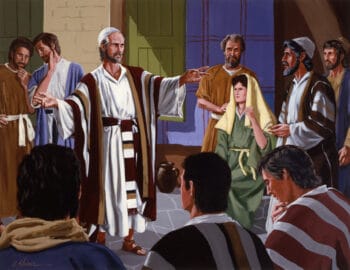
Image © Lifeway Collection at Goodsalt.com
Paul employs strong words to portray the lack of unity among the church members in Corinth. He uses the Greek terms schisma (“division,” 1 Corinthians 1:10, NKJV) and eris (“contention,” 1 Corinthians 1:11, NKJV). The noun schisma (as well as the verb schizō, “to split”) is used elsewhere in the New Testament to describe differences of opinion resulting in factions. In turn, the noun eris (“contention”) frequently appears in lists of vices that must not be practiced by Christians.
Read Romans 1:29, Romans 13:13, 1 Corinthians 3:3, 2 Corinthians 12:20, and Galatians 5:20. What other sins are listed along with eris (“contention,” “strife”)? What does this tell us about how bad it is?
The disagreements in the church of Corinth came to the surface—even in the form of lawsuits against one another (1 Corinthians 6:1-3). “I say this to your shame,” Paul told them (1 Corinthians 6:5, NKJV), concerning these lawsuits between church members. In fact, they didn’t lay aside their differences even when celebrating the Lord’s Supper (1 Corinthians 11:17-22).
The problem of lack of unity among church members is so terrifying, and Paul is so worried about it, that this is the first issue he addresses in this letter to the Corinthians.
|
Read again 1 Corinthians 1:12-27. Then reflect on how this passage helps us understand why cliques are so dangerous to the unity of the church. What can your local church do in order to avoid this problem? |

There is an interesting little twist in 1 Cor 1:12
We get the factional issue of Paul, Apollos and Cephas, but surely saying that “I am of Christ” is where we are supposed to be at, isn’t it?
The issue in this sort of factionalism is there are those who think they are on the high moral ground when they claim to be followers of Christ. Those who make this claim are putting Jesus on the same level as other factional leaders. In many respects, it is spiritual pride. They are using the name of Jesus to justify their own position and are essentially saying their ideas are superior to others.
That’s a very interesting little twist and one that has, up until now , been outside of my understanding . It is a trap that i myself could have easily fallen into . Thanks for the heads up
Had a MD abuse a 5 yr old. His nurse caught him. The church didn’t want 2 report the MD. the father lowly janitor rather than divide the church took his children and changed states.
😭awful
And then there’s the issue of “God spoke to me and said…” and “God told me.”
I’ve had people telling me that God supposedly told them something about me! (I figure God doesn’t gossip.)
I believe we should be very careful about saying, “God told me ….” unless, perhaps, God is revealing something that needs to change in our own lives.
When in discussing an issue, someone puts forth an interpretation as “God told me,” there are several things at work.
1. The individual is very likely mistaking his own thinking/impression as God’s voice, because someone else can come along and say that God said the opposite.
2. The individual claiming “God told me” is establishing authority over others. (Since I’m repeating what God said, you can’t argue with me, or you’re arguing with God.)
3. The person claiming “God told me” is cutting off all possibility of input from others in the body of Christ.
I wonder whether I’m the only person who keeps running into this?
Have you seen/heard this being done?
Even though the Holy Spirit empowered the Corinthian Church, it was plagued by numerous spiritual, moral, and doctrinal challenges. What lessons should our modern churches learn from them? The Corinthian church reminds us that no church is immune from Satan’s attacks. God established His church on the earth as His representative; Satan and his demonic forces are enraged to misrepresent the character of God. No matter how defaced the church might seem to look right now, God will not abandon His church. Our modern church must draw key lessons from the Corinthian church:
1. By all means, Christ must remain the focal point – personalities, traditions, human loyalty MUST never take the place of Christ in the church (1 Cor. 1:10–13).
2. The Corinthian church reminds us that the Church of God is not a museum where perfect people are kept. However, a church is a community of believers who have been called from darkness and are growing in God’s grace.
3. Our blessed hope is not in our perfection, but in the righteousness of our Lord and Saviour Jesus Christ, who is the Founder of the church.
4. The church is called upon to reflect the character of Christ. We must strive to reach our higher calling that is found in Christ Jesus.
5. Differences of opinion are bound to arise in the church; however, they must be settled in love and in unity through the guidance of the Holy Spirit. Love, humility and mutual respect must be the cornerstones in solving differences of opinion (Ephesians 4:1-6).
Thanks for your points
Amen, Brother Omwenga.
I agree with all your points, especially the last one, number 5. We must find a way to settle our differences with “love, humility, and mutual respect”. I will not even mention what is happening instead. The only thing we can do is PRAY for one another. God’s blessing to you.
They say “Evil prevail or thrive when good people do nothing”
Times of disagreement in church should give birth to the emergence of extra-ordinary thinkers and people endowed with reconciliatory spirit by God in order to save the spiritual life of the church and sustain the love existing therein.
But there is a trend of people in these categories walking away when they are needed by God not man, to do their best with the abilities He has bestowed upon them.
The Bible says they should manifest and not abscond!!!!
1 Corinthians 11:19. No doubt there have to be differences among you to show which of you have God’s approval. NIV
1 Corinthians 11:19. for [doubtless] there have to be factions among you, so that those who are of approved character may be clearly recognized among you. Amplified
I have a question please feel free to comment your answer:
If people renown for trouble making or of rebellious character in the church form a faction is it wise for spiritually minded persons to form their own faction too?
My personal understanding is that in forming a faction for the detriment of the believers, the opposite faction is automatically formed just because the remaining believers don’t join the opposing group.
Now, instead of the quartet, which is not a faction. Let us picture a Seventh-day Adventist commemoration (communion) of the Lord’s supper, and ordinance of humility (washing of feet) they are one in harmony and unity. 1 Corinthians 11:19 is just a portion of Paul’s instructing as the communion service you picked up on. As we saw last week, Paul was a preacher in his eyes, though in my opinion he took on the responsibility of a teacher with his letters of instruction to the people of great diversity in Corinth. Reading on, Paul is instructing for the people to move on from quartets (good factions) to every one singing in harmony or unison (an ultra good faction), their pick which by the way sounds beautiful. the congregational choir all participating by being in their respected and usually chosen seat, unless a full house, making up the congregation not all singing in parts but some are and not all singing but many are. Still, all are in the choir for one goal praising the Lord in song. The similarity is found with our observance of the Lord’s supper once a quarter. And ordinance of humility, washing feet together in unison, and by eating the bread wafers and drinking the grape juice in unison following the cue of the officiating pastor.
I believe Paul would want to squelch a faction within a unified organization if he were alive today. What is a faction? It is a dissenting group or individual within a well-functioning organization.
If Paul were visiting the Seventh day Adventist church today for communion and ordinance of humility once a quarter he would say, my letter of instruction was not in vain. 1 Corinthians 11:32-33. The communion and ordinance of humility does exist in the Seventh-day Adventist Church without problem and with reverence. Don’t forget Christ said, “do this in remembrance of me.” There is a reason for the existence of our organization. That does not mean there is not murmuring and that is dealt with in a Christ like manner, of which he gave us many different examples under different circumstances. A faction to squelch a faction I do not believe in. A faction within a Church can happen. Squelching is the duty of deacons and elders under the direction of the church board with the church manual in mind officiated by the pastor.
The Corinthians might have been so convinced of their own spiritual maturity that they assumed the privilege of being judgmental over others. In doing so, they bypassed God’s authority and took it upon themselves to judge teachers, distinguish between the wise and the unwise, establish their own moral standards, and even evaluate spiritual gifts and those who exercised them. Paul reminded them that it was not Paul, Peter, or Apollos who had been crucified for their salvation. Since none of these leaders was their Savior, their loyalty belonged to Christ alone. For this reason, Paul urged them, “I appeal to you, brothers and sisters, in the name of our Lord Jesus Christ, that all of you agree with one another in what you say and that there be no divisions among you, but that you be perfectly united in mind and thought” (1 Corinthians 1:10, NIV). Paul emphasized that the church must be a place of love, unity, and spiritual growth—not a place of competition, pride, or division.
Paul also warned that when cliques begin to form within the church, they spread like a disease, dividing the body instead of strengthening it. When small, exclusive groups become more important than the larger family of believers, people begin to feel excluded, undervalued, and disconnected. Cliques foster an “us versus them” mentality, where favoritism replaces fellowship and gossip overshadows grace. Rather than building one another up, these divisions weaken the church from within. This is not what Christ intended for His body. The church should be a place where everyone—regardless of background, social status, culture, or personality is welcomed, loved, and valued. For; “There is neither Jew nor Gentile, neither slave nor free, nor is there male and female, for you are all one in Christ Jesus” (Galatians 3:28). True unity is found when we tear down barriers, embrace one another as brothers and sisters in Christ, and remember that we are all members of one body. A divided church built on pride and exclusivity cannot stand, but a church built on Christ’s love, humility, and inclusivity will flourish.
Disunity in the church is the devil’s strategy to distract us from the mission of God. To counter that, we need to pray and read scripture.
I have seen both sides of a “Disunity” praying and reading scriptures and thirty years later they are still as disunited as ever. I will have more to say about resolution later in the week, but I think we need to think outside the box on this one.
I agree with Obeng; praying in unity and studying scripture brings unity and the outpouring of Christ’s Spirit. Is not this what enabled Pentecost and the laying down of the foundational truths of God’s remnant church in the 1840’s -1860’s?
Edmund, I am guessing what Maurice is trying to get at is that it’s easy to pray and study and look for whatever you want. Both actions can be manipulative. That doesn’t mean that we shouldn’t do either – we definitely should. But we need to approach both with the right spirit.
Thanks for the inspiration
Prayer and Bible reading will always supersede human wisdom and devices.
Key lesson I got from this lesson is that the church belongs to Christ, not to any individual or group. When believers keep their eyes on Jesus, respect one another, and serve in humility, the church grows stronger in unity and becomes a powerful witness to the world.
Cliques in the church shift our focus away from God. When that happens, our worship can become empty because our hearts are no longer centred on Christ.
May God help us to examine ourselves daily, die to self and walk in humility.
The problem of cliques is an age old one that still manifests itself today. If you were ever excluded from the popular group when you were growing up, then you know how hurtful it can be even as an adult. Everybody has a need for belonging in spite of their lack of charisma, intellect, or ability. I still remember the pain of neither team captain wanting me on their team and being chosen last. I remember when I was a teenager, about 15, 16 years old, and my little brother (5 years younger than myself) wanted to hang out with me and my friends and I told him to hang out with his own friends. With tears in his eyes he said, “I don’t have any friends.” I felt bad that I, being his oldest brother, the one that he looked up to, was causing him to feel rejection by me. I relented and told him that it’s okay if he hung out occasionally with me and my friends.
Everybody has a desire to be part of the group. We were created for community. We should go out of our way to befriend or involve those that seem to not have a place of belonging in the church, or in society. There are so many lonely people out there, even in the church, that may be hanging on by a thread of hope that someone would acknowledge them and include them in the conversation or fellowhip. That’s a ministry too, called hospitality.
Conversely, we should resist the impulse to put others on a pedestal, lest they fall and we are brought down with their fall. Jesus is the only one that we can safely “put on a pedestal.” He is all inclusive in giving the invitation to mankind (Matt. 11:28-30) and he is the only one that won’t let us down. Let’s go out of our way to invite others to be on Jesus’ team. In the eyes of the world believers may be considered “losers”. With Jesus, no one is a loser. With Him all of the so-called “losers” win.
Strangely, from my childhood, I was never part of the popular group. I was aware of it, but it never kept me from enjoying life. Even today, I sometimes have the same experience. Yet there is something within me that allows me to shrug it off and keep living my life with joy and purpose. I don’t need to be included in every circle to know my worth.
Avoiding factions and cliques is difficult. I definitely don’t have the answer but two simple things may help in the church:
1. Assume the best about people. We are very quick to label people (liberal,legalist,heretic, etc.). Even if we don’t say it, we often think it
2. Do more listening than talking. Earn the right to be heard
There are differences of opinion on certain matters in the church that are not salvific. We should not allow these differences to divide us, attack church leadership, or create ongoing confusion in God’s church. While we may disagree on nonessential issues, we are called to preserve the unity of the body of Christ and keep our focus on the mission He has given us.
Cliques seem more prominent where people are most resistant to change or to newcomers. Am I willing to change my heart? Because in the journey to building a better character, there is certainly a need for change. May I let the Holy Spirit freely act on the changes I need to face.
An interesting twist for me is in 1 Corinthians 1:20. In the midst of all the chaos and disunity in the Corinthian Church, Paul asked, “Where is the wise? Where is the scribe? Where is the disputer of this age? Has not God made foolish the wisdom of this world?”
Paul left the Corinthian Church with able bodied, good Leaders (scribes are Leaders) to support, uphold, and led the church. Paul is now asking: Where are those Wise and Good Leaders that were there to “uphold God’s standards” for the Corinthians church?
I’ll tell you the answer to Paul’s question: Those Wise Scribes, the Leaders, became Disputers. But they were supposed to dispute (debate) with the church, when necessary, in order to uphold the Standards of God in the church. Where are They? They were still there, but they have been “silenced”. They were excluded, or removed from their leadership, because a) the rest of the church either did not want to listen to wisdom, or b) those leaders did not fit into the new agenda of the Corinthian Church; the agenda that says “we want to do what we were to do, when we want to do it, and how we want to do it (which is our human nature); we don’t want to be under the standards of God, and we don’t want anyone telling us to do that”.
This “silence and removal” of Wise Leaders is still happening in our Seventh-day Adventist Churches today. Many of our churches have their own agendas, and if anyone (Leader or Member) disputes that agenda, then they will be either ostracized or removed. And to take this silence/removal issue further, if a Leader, or a concerned Member, dares to stand up and dispute the agenda, then they are viewed as being a Very Negative Person, and not an Encourager. I know this from personal experience, because it was done to me about a year ago.
But my question is: If the church doesn’t have an agenda, and they successfully got rid of the Disputers, then shouldn’t people notice the “Improvements” in the church? But instead of improvements in the church, people are noticing that all the same issues that plagued the Corinthian Church are now happening in our modern-day churches too. Instead of Improvement, our churches are getting Worse. This is largely because the church no longer wants to listen to Wisdom, or the council of Wise Leaders that were placed there by God to do His Will.
I sometimes think that our church is on an agenda to assimilate into the rest of Christendom, where we feel that we will have more “influence”. Back in the day (Old Testament and modern times), “influence” was a characteristic of a Wise Person, those that have Wisdom. But now, “influence, the influentials, and the influencers” are concepts that are no longer so clear. Oh, My God; Lord, please have Mercy on us!!
In these last days, the only thing we can do is PRAY; Prayer changes all things. We need to Pray for the church, pray for our Leaders, and Pray for ourselves that we will hold on to the “Ship of Zion”, which is Jesus.
Be blessed everyone!
Toni, you have just verified that human nature hasn’t changed since the time of Paul. That’s why we still have similar problems in our churches. And the solution remains the same: Keep our eyes on Jesus, not on any human leader. If we all seek to come close to Jesus, all our relationships will improve.