
Monday: Identifying True Prophets

Daily Lesson for Monday 12th of October 2026
In the early history of Israel, there is evidence of false prophets (Deuteronomy 18:20). God, therefore, did not leave His people without guidance on who His true prophets were.
As recipients of God’s revelation and inspiration, true prophets faithfully, accurately, and honestly transmitted God’s messages, even if, at times, this made them unpopular with the people in power.
Read 1 Kings 22:1-14. What does it tell us about how faithful prophets operate?
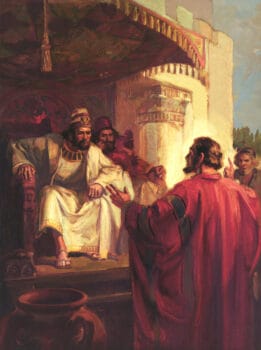
Image © Providence Collection at Goodsalt.com
To have a king say of a prophet that “ ‘I hate him, because he does not prophesy good concerning me, but evil’ ” (1 Kings 22:8, NKJV) says a lot about the king, but more about the prophet. He was, obviously, a man not afraid to speak the truth, even to the king himself—not a way to win royal favor, to say the least.
Micaiah stood alone against 400 false prophets as he presented the truth revealed to him. In the face of coercion to alter negative messages from the Lord to placate evil King Ahab and his wife, Jezebel (1 Kings 22:13-14), Micaiah presented God’s truth, regardless of how it might be received.
Read 1 Samuel 9:3-14. What do these verses tell us about how others viewed faithful prophets of God?
There are numerous examples of the quality of life lived by prophets in the Bible. In this case, Saul was sent by his father, Kish, to look for his lost donkeys. The servant traveling with Saul suggested that he not abandon the search, because there was “ ‘in this city a man of God, and he is an honorable man’ ” (1 Samuel 9:6, NKJV). The description given here of Samuel the prophet depicts the qualities expected of God’s prophets. True prophets in Scripture are identified as “men of God,” chosen in part to exemplify His character. At the same time, just because some among the “men of God” may be prophets, this doesn’t make them flawless human beings.
|
Who, even among the most esteemed “men of God,” have you known to be flawless? |

Why is it critically important to identify true prophets? Did the Children of Israel essentially go astray because they followed false prophets or because they refused to follow the messages of the true prophets? Why are the messages of false prophets “sweeter and attractive” than the messages of the true prophets?
It is essential to note that people went astray both by accepting false messages and by rejecting God’s genuine messengers. Time and time again, God sent His messengers to the Children of Israel, but they rejected them, refused God’s messages and followed false teachers and false prophets. Can one make a hypothesis that rejecting God’s prophets and God’s messages ends up in following false prophets? Persistently walking away from God’s truth ends up in embracing falsehood. There is a great danger for the persistent rejection of God’s truth creating a spiritual condition in which people become vulnerable to falsehood and eventually preferring false prophets to the true messengers of God.
“A horrible and shocking thing has happened in this land – the prophets give false prophecies, and the priests rule with an iron hand. Worse yet, my people like it that way!
But what will you do when the end comes?” (Jeremiah 5:30-31, NLT).
Why would people welcome false prophecy? Jeremiah provides a possible explanation, “my people love to have it so.” The danger for rejecting and refusing the true messages from God true prophets is that it creates an inclination towards false teachers and prophets and their falsehood. People have a propensity not to like sound teaching, warnings, rebukes and the impending judgment. People do not want to be challenged by the truth. People dislike being “disturbed” by the truth. People want to hear what their “hitching hears” want to hear.
“For the time will come when people will not put up with sound doctrine. Instead, to suit their own desires, they will gather around them a great number of teachers to say what their itching ears want to hear. 4 They will turn their ears away from the truth and turn aside to myths.” (2 Timothy 4:3-4, NIV).
Last week, we read the following text from the Book of Isaiah “Stop seeing visions! They tell the seers, ‘Stop seeing visions!’ They tell the prophets, ‘Don’t tell us what is right. Tell us nice things. Tell us lies.” (Isaiah 30:10, NLT).
The surest and most authentic way to identify false prophets is to embrace and live by the messages of God’s true prophets.
Thanks for your input, nowadays some people just want to be told lies, or just do almost nothing to stop it, worst is running away not to be part of the correction.
1. The Sin of Doing Nothing
• James 4:17 – “If anyone, then, knows the good they ought to do and doesn’t do it, it is sin for them.”
This is the closest New Testament parallel to the idea that staying passive when you should be acting righteously is inherently wrong.
2. Failing to Intervene to Save Others
• Proverbs 24:11-12 – “Rescue those being led away to death; hold back those staggering toward slaughter. If you say, ‘But we knew nothing about this,’ does not he who weighs the heart perceive it? Will he not repay everyone according to what they have done?”
This directly warns against pretending not to see wickedness or danger as an excuse for doing nothing.
Someone has to take action may God help us be that ” someone”
Unfortunately, despite the distinctive understanding of Scripture that God has entrusted to us as a denomination, we are seeing a growing tendency among some Adventists to reinterpret doctrines—not because the biblical evidence has changed, but because the doctrines no longer fit comfortably with prevailing lifestyles, cultural values, or personal preferences.
The danger is not always rejecting truth outright. Sometimes it is redefining truth until it no longer confronts us.
The broad road is attractive precisely because it requires less surrender. But discipleship has never been about reshaping God’s Word to fit our lives; it is about allowing God’s Word to reshape our lives. When a doctrine challenges our preferences, the question should not be, ‘How can I reinterpret this so that I can remain comfortable?’ but, ‘Lord, what are You asking me to surrender and obey?’
Parable of the vineyard says it all. You have to be aware of your sin before you can turn from it. Holy Spirit speaks through the prophets to the church. What a blessing.
Micaiah is a reflection of courage and integrity that distinguish a true prophet of God from other prophets. When four hundred prophets stood before King Ahab, promising victory, Micaiah stood almost alone, unwilling to exchange divine truth for any form of royal approval. His conviction was unwavering: “As the LORD liveth, what the LORD saith unto me, that will I speak” (1 Kings 22:14, KJV). He understood that a prophet’s responsibility is not to tell people what they want to hear, but to proclaim what God has revealed, even when the message invites rejection, imprisonment, or suffering. While others spoke to please the king, Micaiah spoke to honour the King of kings. His experience reminds us that the voice of truth is not validated by the size of the crowd, but by its faithfulness to God’s Word. As Paul declares, “For do I now persuade men, or God? or do I seek to please men? for if I yet pleased men, I should not be the servant of Christ” (Galatians 1:10, KJV).
The responsibility to identify a true prophet lies on the hands of people, one has to first know who God is , what God is capable of doing, then it will be easier to identify the prophet of that God. When God’s prophet give their input (of course from God),that will help people to have that strong bond to God. Identity comes first, God did it first, we follow suit, so whom do you identity yourself with?
Oh what manner of trust I see here.
I am trying to bring this home if God sent me today to give a message of rebuke to my head of state what would my response be.
1.oh but I am a youth will be listen?
2.how will I get an appointment?
3.how will I get there ?
4. What of my family?
These may seem like reasonable questions but they don’t come from a place of trust it should be when I am going?
Trust is an important quality.
OH WHAT MANNER OF TRUST
It is easy to come up with a few quotes to support identification of true prophets. For example:
However, in practice, many biblical prophets were not recognised as such until after their deaths. Further, they were often ignored or vilified. Being a prophet was seriously dangerous. Jesus refered to this:
There is, of course, one primary reason for this; The messages of the prophets did not scratch the backs of the listeners. They prophesied words that they did not want to hear.
It is interesting to read the history of developing the Old Testament Canon. The books of Ezekiel, Daniel, and many of the minor prophets were questioned. Ezekiel, in particular, described temple procedures that seemed to contradict the law, and it took a long time for it to be accepted.
I mention this because sometimes we make it look as though it is very easy to identify true prophets/prophecy. It is actually quite complicated. I don’t think that needs to be discouraging. It is helpful to have a robust debate about what we understand because it has the potential to develop and grow. When I get involved in these sorts of issues (all too often in our age) I like to remind myself:
Perhaps God has some “prophets” right now whom we do not recognize?
I believe that if we spend enough time in the Word of God to hear His voice, we will also recognize His voice through modern “prophets.” 1 Cor. 2:14
The road to Emmaus.
They had the Scriptures explained to them, and still they didn’t get it. They were walking around claiming to be His disciples. Still they never
recognized Him after He’d already told them the Scripture for that age,
where God had allotted it. He said, “Don’t you know that Christ should
have suffered these things, and entered into His glory, and raised
again?” They should’ve known it. He said, “Know you not all the prophets said about Christ?” And He began back there and explained the whole thing down to them, and laid it out to them. And still they never recognized Him. After laying the Scripture out, just as perfect as it could be, and then walking around it, supposed to be His disciples. “Oh, is that so? Is that so?” And yet He was that Scripture fulfilled standing there. And still they didn’t get it. See?
The story of King Jehoshaphat, king of Judah Insisting that King Ahab King of Israel , get a Prophet of God to seek God for Advice, tells us that a prophet of God will only say what God tell him to say, as what Micaiah did, “I will tell only what the Lord says to me.” 1 Kings 22:14.
True prophets of God will not be swayed to tell otherwise. True prophets have the reputation of being a prophet of God. Are true prophets infallible. No, but when they make mistakes they repent and ask for forgivness. Are not we true prophets in the broad sense of the word? Yes, we are messengers of the gospel of Christ. 2 Peter 3:16. Titus 3:1-2
A side note there one verse that informs, even humbles us if we allow, by saying we are save not by our own works rather by the One who died on the Cross to save us. Titus 3:5. Praise God. Amen and amen.
Since even true prophets are human, they may try to modify God’s message.
Ellen White tried that at the beginning. She tried to soften the messages God gave her to pass on. But God rebuked her severely, and afterward she was more afraid of changing the message than of “hurting” people.
Paul said after accepting Christ he now hated what he used to love and loved what he used to hate , his priorities changed. Having Christ to him was like having everything and lacking in nothing.
I think that the essential question is not wiether or not these men were flawless. The essential question to my mind is wiether the general trajectory of thier lives were Godly. We do not judge a person’s character by thier occasional good deeds or misdeeds. But by the habitual trend of thier words and actions. In fact we hold men and women who speak on God’s behalf to a higher level of speech and conduct. It is only fair and just that the receptable that carries the ” Word of Jehovah” possess some auror of beauty ; and the greatest auror of beauty , is the beauty of a Godly and Godlike character.
The history of the world that most people have rejected the messages from their Creator, the God of the universe, Who knows everything about everything, Who desires nothing more than our eternal happiness, Who knows the end from the beginning, Who has our eternal welfare at heart, Who loves us with an everlasting love, Who longs to have a personal relationship with us, Who wants to give us eternal life in paradise with Him, is a sad commentary on the human condition. Instead of dreading messages from God, we should be longing for them. This history highlights the conflict between our natural will and God’s will, pointing out our need of Jesus to save us from ourselves.
Steve, you are right let me add that the aurora of beauty in the Bible is also what the God has done for us in spite of our mistakes and is continuing to answer Jeremiah’s prayer in Jeremiah 17:14,16.
Are prophets not given to us to warn us, to point out when we abandon God that we will lose our way and become ensnared by the tangles of this world? Who rejects God’s Truth and Wisdom? Who scoffs and talks down to those wanting to help bring about righteousness and goodwill by pointing to God? Is it not those who are well-adjusted and comfortable with the status quo, those who benefit when keeping the Truth repressed?
The lost think they have only one life to live, so they want to live it to the fullest. Who would ‘lose’ the most if God’s Truth comes out? The poor or the rich; the weak or the powerful; the ones without or those firmly established in the order of the fallen, materialistic world?
The prophets speak to the dangers of a life lived without God, whiles His adversary ensnares those seeking earthly treasures and power. He knows it will blind them to seek and hear the true God’s voice. God’s warnings to change their ways threaten this singular focus on a successful life here and now. Having become deaf and blind to God’s Wisdom, desperate to keep their gains, they are willing to kill the messengers. Ironically, if they could only understand that God’s Righteousness establishes the most fulfilling life – John 16:33.
Well, from the Bible, I’m not sure that the prophets were all flawless. Perhaps Enoch (the Bible only mentions how closely he walked with God). The only flawless prophet was, without a doubt, Jesus!
Why did King Jehoshaphath insist getting another prophet? Did he know that these are false prophets?
It seems he did not feel comfortable with them. Whether he knew for sure they were false prophets is hard to determine, but he could see they were just saying the same things and what Ahab wanted to hear.
Hi Robert, the fact that he asked for a prophet of the Lord in 1 Kings 22:7 reveals he knew the first ones were false prophets. He was a good king, meaning, he walked in the ways of the Lord.