
Sunday: The Humanity of Prophets

Daily Lesson for Sunday 11th of October 2026
As we saw last week, the Lord used Elijah the prophet to do a tremendous work in Israel, despite fervent opposition. What the Lord had accomplished through him was incredible. And yet . . . what?
Reflect on how James presents Elijah the prophet in James 5:17-18. What might he mean by saying that Elijah had “a nature like ours” (NKJV)?
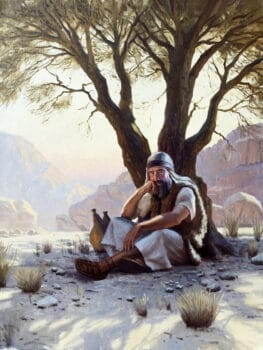
Image © Lifeway Collection at Goodsalt.com
Elijah had a stunning success on Mount Carmel (1 Kings 18:1-46); God had worked in a mighty way through him, and one of the most astonishing miracles depicted in Old Testament history occurred: at the sound of Elijah’s own words, fire literally came down from heaven (1 Kings 18:38)! You would have thought that this man of God would have been exceedingly happy after something like that.
Read 1 Kings 19:1-16. What does this tell us about the emotional state of God’s prophet?
“ ‘It is enough! Now, Lord, take my life, for I am no better than my fathers!’ ” (1 Kings 19:4, NKJV). This sounds like a man suffering from some form of depression. Why? What happened on Mount Carmel would not be an easy act to follow, for sure, but, still, something else is going on here.
Perhaps the key could be found in his words, “ ‘I have been very zealous for the Lord God of hosts; for the children of Israel have forsaken Your covenant, torn down Your altars, and killed Your prophets with the sword. I alone am left; and they seek to take my life’ ” (1 Kings 19:10, NKJV). This sounds as though he’s lamenting what he believes to be his failures in ministry. Apostasy remains, despite his best efforts, as if he alone could have stemmed the tide. Whatever ultimately is going on here, we can see the humanity and fragility of this man of God. In other words, Elijah was a man who had “a nature like ours.”
|
Why might it be easy at times to have a sense of “failure” in your own life or endeavors? What Bible promises can you claim to help you work through discouragement? |

Why would a holy God entrust His sacred messages to flawed human beings? Could God not have chosen angels who were morally perfect, intellectually superior, strong, swift and incapable of making mistakes? Who can question God’s divine sovereign authority? However, the Bibles provides us with some insights.
“But we have this treasure in earthen vessels, that the excellency of the power may be of God, and not of us.” (2 Corinthians 4:7, KJV).
The authority of God’s messages does not originate in the perfection of its human messengers. The human instrument does not add value to the message because it originates from a holy God. The attention is not in the messenger but in the message. Nobody should place confidence in the messenger but in the source. God’s authority is magnified in human weakness.
God called imperfect human beings so that His grace may manifest. “My grace is sufficient for thee: for my strength is made perfect in weakness.” (2 Corinthians 12:9, KJV). The humanity aspect of the prophets is a reminder that God is willing to work with feeble beings to accomplish divine assignments. If we are willing, we can be useful instruments in God’s hands. God does not call the qualified or perfect human beings. In the first instance, there no qualified or perfect human beings. All what God wants is willing hearts with teachable spirits.
“Remember, dear brothers and sisters, that few of you were wise in the world’s eyes or powerful or wealthy when God called you. Instead, God chose things the world considers foolish in order to shame those who think they are wise. And he chose things that are powerless to shame those who are powerful. God chose things despised by the world, things counted as nothing at all, and used them to bring to nothing what the world considers important. As a result, no one can ever boast in the presence of God” (1 Corinthians 1:26-29, NLT).
Are we willing to be made willing?
Out of this weeks’ time frame yet a good illustration. God also calls prophets that are willing to be made willing. Let me tell you she was made, not coerced to be willing. Yes, for her, God’s grace turned out to be sufficient. Look at this testimony of Ellen White.
https://egwwritings.org/read?panels=p28.226&index=0
Prophets were first human and had real everyday strugles like we do. For example Elijah like us had feelings, weaknesses, and limitations. “Elias was a man subject to like passions as we are” (James 5:17, KJV). As much as he boldly confronted an evil and mean King Ahab, stood against the prophets of Baal, he also experienced fear and discouragement. When Jezebel threatened his life, Elijah fled into the wilderness and, overwhelmed by despair, asked God to take his life (1 Kings 19:3–4). This reveals that even a mighty prophet could experience moments of emotional weakness. Yet, God did not reject him in his lowest moment; He provided food, rest, and encouragement (1 Kings 19:5–8). Elijah’s experience is a stark reminder that being used by God does not mean being free from human struggles.
The stories of prophets in the old testament clearly teach us that the Lord is not looking for spiritual giants to use for His glory. But He is simply looking for people who can willingly and readily obey His Word and follow Him where He leads. Nothing at all is known about Elijah until he steps onto the scene in the presence of King Ahab. He was a nobody from nowhere, but he was handpicked by the Lord God to do His will and carry His message to a wayward nation. God has chosen to work through men and women who will yield themselves to His will, just as Isaiah declared, “Here am I; send me” (Isaiah 6:8, KJV). Elijah’s devotion was rooted not merely in obedience but in a personal relationship with God. His life teaches us that God does not require human perfection; He desires a willing heart that trusts Him, loves Him, and remains available for His service (1 Samuel 15:22).
There are two things I have learned from failures:
Elijah’s failure experience was a moment when God could get through to him, both to encourage him and to repurpose his life. It was part of the spiritual development experience. Our spiritual lives have, and will have, highs and lows. We are not alone in the lows.
One thing I can see here Elijah is sad but he is still in the presence of God.
Many are the times we are overwhelmed by emotions that we leave His presence and come back when all is well emotionally. Let’s be encouraged by Elijah .
As human beings, we make mistakes, experience disappointment, and sometimes become discouraged when things do not go according to our expectations. These experiences remind us of our human weaknesses and limitations. Yet, God, in His wisdom, can work through our weaknesses to accomplish His divine purposes.
Elijah was a human being just like us (James 5:17). Despite his great faith and powerful ministry, he experienced fear, discouragement, and despair. However, God did not forsake him in his moments of weakness. Instead, God cared for him, strengthened him, and continued to use him for His work.
**This lesson has taught me that, irrespective of the afflictions, disappointments, failures, and difficulties I may encounter in life, God has not abandoned me. My moments of weakness do not mean that God has rejected me, and my disappointments do not mean that His plans for my life have ended.**
Just as God was with Elijah in his darkest moments, I can trust that He is with me through every season of life. I must therefore learn to trust His timing, depend on His strength, and remain faithful even when life does not unfold as I expect.
What a fascinating story is that of Elijah the prophet. One area of particular fascination is that of Elijah fleeing from a woman, Jezebel, after such an amazing display of courage, bravery and steadfastness on Mount Carmel. How could such a thing occur?
The first idea that kicks in, is the quest for a psychological explanation. What are the stories of his life history with women? What type of person was his mother? Did he have sisters ? What type of relationship did he experience with them ? Did he have a wife ? What type of woman was she? However little, if any information is given on the background of this prophet. And the questions can continue as we seek to understand why such a mighty prophet of God who “brought fire down from Heaven” could run like a little pussy-cat from an enraged woman.
One of the clues we can derive is from Elijah’s own words whilst speaking to God on both mountains: “I alone am left.” Firstly in 1 Kings 18:22, Elijah says this to the Israelites on Mount Carmel before confronting the 450 prophets of Baal. Here his solitary stance for God is contrasted with the vast number of idol worshippers.
Secondly in 1 Kings 19:10 and 19:14, Elijah repeats this statement to God whilst hiding in a cave at Mount Horeb (Sinai) after Queen Jezebel threatened to kill him for executing the prophets of Baal.
Wouldn’t it be a wonderful thing if we would practice the habit of encouraging our Spiritual leaders in the Lord. I have personally experienced the “loneliness” of Leadership. I admit I was not the most friendly of Leaders, but nonetheless an encouraging word, acts of kindness received from those you serve, etc., can make such an awesome difference to your ministry .
Perhaps, I don’t know for sure, but Elijah’s words seems to to convey the message- “I alone am left” -perhaps if the Israelites were more encouraging and embracing of this solitary prophet, he may not have uttered those words and he would have been emboldened to face that woman.
Elijah’s experience reminds me that perhaps the healthiest posture when confronting problems within God’s church is:
“Lord, show me what You want me to do within the sphere of influence You have given me. Give me the courage to do it faithfully, the humility to recognize the limits of my responsibility, and the faith to leave the outcome with You.”
This keeps us from two opposite errors: indifference, which says, “There is nothing I can do, so I will do nothing,” and assuming Christ’s responsibility, which says, “It is my job to fix the church.” Neither is our calling. We are called to be faithful witnesses, while remembering that Christ remains the Head of His church.
And sometimes what appears to us as failure may simply mean that God is still working beyond what we can see. Our responsibility is faithfulness; the results belong to God.
Elijah experienced deep emotional distress, and God responded with compassion, care, and understanding (1 Kings 19:1–18).
Sadly, in some Seventh-day Adventist churches, people who disclose that they have depression, anxiety, or other mental health conditions face stigma, judgment, and rejection. Some are excluded from church activities and responsibilities, while others are avoided when they need support the most.
Why reject people who are already struggling? Shouldn’t the church be a place of love, healing, and encouragement rather than discrimination?
Mental illness does not mean a person lacks faith. People can love God, pray, and still need professional help and emotional support.
Jesus taught us to love one another. Let us stop stigmatizing mental illness and start showing compassion. People who are hurting need support, not rejection.
In 1 Kings 18:13-14 it says that Elijah hid one hundred prophets, 50 each in two caves. What happened to these prophets? Elijah said that he alone was left, but I am left wondering what I missed. I’m sure someone who contributes in this forum can explain this. Thank you!
You are quite right. Obediah who was part of the court and a God-fearing man, hid 100 prophets from Jezzabel. I think that Elijah felt the responsibility personally, and that led to his despair. When you have been the spokesperson for the cause, it is sometimes difficult to see who is behind you. Elijah lost that vision and felt alone. In Elijah’s desert experience, away from the limelight of conflict, God told Elijah to adjust his eyesight, because there were 7000 in Israel who had not bowed the knee to Baal.
God did not promise us that we would never fail. But He said that He would be with us in our challenges. Thus, even a prophet can face frustrations and discouragement. The difference is that hanging on to the Lord is always worth it!
I praise the Lord for each of you and the discussions you contribute to – they enlighten my studies and get me thinking beyond as most times I feel like Elijah, that my efforts are in vain but God assures me that He never fails me even in my lowest times of discouragement – He never leaves me hanging.