
Tuesday: Isaiah, the Gospel Prophet

Daily Lesson for Tuesday 6th of October 2026
Isaiah, a major prophet of the Old Testament, received His call to prophetic ministry directly from God (see Isaiah 6:1-8). Overwhelmed by God’s holiness and majesty, Isaiah realized his unworthiness. In that moment, a seraph flew to Isaiah with a live coal from the heavenly altar and “purged” his sins. God then asked, “Whom shall I send, and who will go for us?” Isaiah’s response should be ours: “Here am I; send me” (Isaiah 6:8).
Isaiah’s call came at a pivotal point in Israel’s history. Despite his own failings, the task of warning Israel and its leaders of their sins was very important. Isaiah’s prophecies are key Scripture passages, providing profound insight on God’s nature, the nature of humanity, and the unfolding plan of salvation. In fact, what is unquestionably the most powerful prophecy depicting not only the death of Jesus but what His death did for the world is found in Isaiah 53:1-12.
Read Isaiah 53:1-12. How did this amazing prophecy, written more than half a millennium before the Cross, so powerfully reveal Christ’s death for us? What should this prophecy teach us about the prophetic gift?
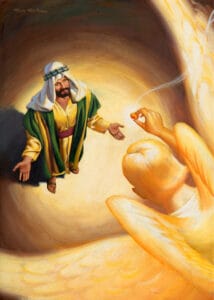
Image © Review & Herald Publishing at Goodsalt.com
Isaiah’s prophecies foretold the Messiah’s purpose and mission (Isaiah 53:3-5). They explained why Christ was “led like a lamb to the slaughter” (Isaiah 53:7, NIV) and how His atoning sacrifice saved His people from their sins. The substitutionary aspect of Christ’s death is so explicitly depicted there, showing the foundation of the atonement made on behalf of all humanity.
“All we like sheep have gone astray; we have turned every one to his own way; and the Lord hath laid on him the iniquity of us all” (Isaiah 53:6). The universal nature of sin is depicted here; the universal nature of the Cross, the solution to sin, is depicted here as well. This chapter, perhaps more than any other in both the Old and New Testaments, shows the plan of salvation in such clear and unambiguous terms.
Yet, Isaiah’s prophetic calling was not easy. People found his dire predictions of their destruction preposterous, as many do today when warned about the consequences of sin (Romans 6:23). Isaiah’s prophetic voice for his time and ours is clear (see Isaiah 2:4, Isaiah 5:20). It was the refusal of the nation to practice justice and reform that led to Jerusalem’s destruction. The same sin will mark the destruction of earth’s wicked inhabitants when Christ returns.
|
Go back through Isaiah 53:1-12 and write down everything that Jesus does for us, as depicted in those verses. What great hope can you take for yourself from what the prophet has revealed about what Christ’s death has done for us? |

The prophetic messages of Isaiah have some promises that vibrate in my soul profoundly. Life as we know it here on earth has sharp corners and terrifying terrain. God’s message through Isaiah’s assures me that one day all these will come to an end.
“Look! I am creating new heavens and a new earth, and no one will even think about the old ones anymore” (Isaiah 65:17, NLT).
I know I am not alone with sharp corners and twists of life. I need a complete change in my life. I need rest. I need pure joy and happiness. All these are far-fetched dreams on this earth. Isaiah’s message makes a lot meaning because it is only God who can make things new. A change in the global economy will only bring a smile to some people, and for a while. Until the time when God will create new heavens and a new heart, there will be sickness, death, pain, sorrow, tears, and crying. This is the ultimate comfort and hope. Till then, Dear Loving Saviour, please keep us faithful and steadfast in your truth till you come back again. Amen
Isaiah is a fairly complex prophet and we often jump directly to the messianic prophecies because Jesus pointed our attention to them. That is fair enough, but it is important to see the big picture and not just the end game.
The first part of Isaiah is a warning to Israel that their apostacy would lead to exile. It wasn’t just Baal worship that was a concern but also their substitution of religious observance instead of looking after the welfare of those in need. Isaiah was also concerned with the alliances the Israel was making with nations around them in the hope that it would save them. Isaiah was quite demonstrative about this and it is recorded that on the instruction of God, he went naked and barefooted in public for 3 years to illustrate their vulnerability. (Isa 20) I imagine that we would certainly notice a naked prophet in our modern world, but we would probably disregard his message!
While the first part of Isaiah’s prophecy is about apostacy and consequent exile, the second part centres on hope and restoration. Perhaps the original intent was pointing to the period of restoration after the Babylonian exile, Jesus refocused these prophecies on himself. Jesus is essentially saying that he is the restoration.
The restoration message is still relevant today. We are to be part of the restoration Read Isaiah 58. Here is a quote just to give you an idea.
There is a lot more but if gives a picture of what God expects a restoration to look like. Now that is the sort of prophecy that is relevant to us.
I think Maurice that both are relevant to us. The actions and attitudes towards the poor and needy encouraged by Isaiah (Isaiah 58) annihilates the argument by some; that Christians are so heavenly minded that they are no Earthly good.
Yet Isaiah points to the future blessings to be derived from Christ’s death and sufferings to which we can look forward with anticipation.” See, I will create new heavens and a new earth. The former things will not be remembered, nor will they come to mind. But be glad and rejoice forever in what I will create,..” Isaiah 65:17-18 NIV
In addition we have the present benefits; ” …the punishment that brought us peace was on him, and by his wounds we are healed.” Isaiah 53:5 NIV
I agree, Steve, It is important to clearly keep a dual focus – on Jesus the crucified and risen Saviour our future hope AND how He wants us to reflect his character by out practical love for others here and now.
Isaiah, the Gospel Prophet, speaks directly to weary souls, for he saw a world filled with broken promises and empty pursuits, yet proclaimed the One who alone can satisfy the deepest thirst of the human heart. Through Isaiah, God asks, “Wherefore do ye spend money for that which is not bread? and your labour for that which satisfieth not?” (Isaiah 55:2). He puts a spotlight to many that are going from pleasure to pleasure, relationship to relationship, achievement to achievement, only to discover that the cisterns of this world cannot satisfy! Isaiah points us away from these broken cisterns and toward Christ, the true Fountain of living water. “Ho, every one that thirsteth, come ye to the waters” (Isaiah 55:1). The Gospel Prophet reminds us that we do not have to remain exhausted, deceived, and spiritually thirsty; there is a Saviour who asks only that we come, trust, and receive. Why continue paying the heavy price for what leaves the soul empty, when Christ freely offers forgiveness, peace, purpose, and eternal life? Come to Him—He will never deceive you, and in Him the thirsty soul finally finds rest.
Very often I contemplate my sorrows be it intentionally or unintentionally, basically feeling sorry for myself, you know the ‘woe is me attitude’. And then I studied today’s lesson and I shed tears of shame for my selfish thoughts, ways and deeds.
Reading Isaiah 53:4-9, for me this really brought to light, John 3:16 in a more profound way.
We can only thank God our Father for choosing prophets to help us understand what Jesus Christ has sacrificed for us and provided us with an opportunity to choose Him.
“Christ was treated as we deserve, that we might be treated as He deserves. He was condemned for our sins, in which He had no share, that we might be justified by His righteousness, in which we had no share.” (The Desire of Ages, p. 25).
Encouraging
Critics sometimes point to Ellen White’s human flaws as though a prophet must be personally flawless in order to be used by God. But that is not the biblical standard. Isaiah was a man of “unclean lips,” David was a sinner, Elijah became discouraged, Peter denied Christ, and Paul had persecuted God’s people. Yet God used them powerfully. Their humanity did not disqualify them to be called. At the same time, their calling did not make them sinless. They too needed a Savior. The question, therefore, should not simply be, “Did this person have flaws?” The biblical question is, “What did God communicate through this person, and does that message stand in harmony with Scripture?”
The point is, we can defend the prophetic gift without pretending the prophet was incapable of human weakness or error.
The ppassage of Isaiah 53:4-6 especially details what Christ has done for us. The entire passage of Isaiah 53:1-12 describes what he went through to save us.
The great hope is that because of what Christ has done for me personally, and humanity corporately, the offer of salvation has been extended. It’s something that we could never accomplish by virtue of our own efforts or works. The free gift aspect of it makes it even more amazing, and vauable. Everything that Adam lost has been redeemed. The choice is ours whether we by faith will benefit from all that Chrst accomplished on our behalf.
The lesson’s author asks the question: “Go back through Isaiah 53:1-12 and write down everything that Jesus does for us, as depicted in those verses. What great hope can you take for yourself from what the prophet has revealed about what Christ’s death has done for us?
Isaiah 53:12 What Jesus has done for us:
He bares our griefs;
He carries our sorrows;
Though oppressed and afflicted, He opened not His mouth;
He poured out His Soul unto death;
He made intercession for the transgressor;
The LORD has laid on Him the iniquity of us all.
What man does to Jesus:
Despise and rejected Him;
Esteemed Him stricken, smitten by God, and afflicted;
Oppress Him and afflict Him.
What did God do for Him:
Because He poured out His soul unto death, and was numbered with the transgressors, and bore the sin of many, and made intercession for the transgressors – therefore I will divide Him a portion with the great, and He shall divide the spoil with the strong.
The prophet Isaiah points to the past, the present, and the future of Israel, and the message is applicable to our days as well. Though Jesus’ death would mark the lowest point in Israel’s history, at the same time, it demarked the highest point of God’s Love for His people.
Jesus Christ’s life and death bare witness to the work our heavenly Father engages in on behalf of man’s redemption. Because God sent His Son to show us the Way of Life first, we cannot only look to the cross – His Life defines the Cross for us.
God needed to show man the utter depravity of sin and its consequeces. Isaiah brought the message of God’s Justice, Forgiveness, Mercy and Grace! God’s message did not stop with him declaring the consequences because of Israel’s sin. He was also given to declare God’s power to redeem them. He pointed into the future to Jesus Christ, God’s Son, our Savior. As it was then, so it is now – mankind’s greates hope remains God’s Forgiveness!
Jesus humbly took our blame and our pains, offered Himself as a sacrifice, died for us, and justified us, giving us peace and healing! What a mystery it is not to accept this gift!
And we have this wonderful promise!
“By beholding Him we become changed into His likeness.” CH 590.2
I like how the author points out the obvious message of Isaiah 53. The Message being our understanding of the plan of salvation. Most of us know this message, yet it helps us to review it. There are multiple gems from Isaiah as mentioned in the blogs today. The mention of the author that, we like the Jewish nation for the most part could be caught in the same situation of sheep led astray in these last times of earth’s history, is relevant to us today. What we can do.
Now, if we are partaking in the Sabbath School lesson, and/or other Biblical material, spending time with the Lord daily, asking, and claiming the promises that the Holy Spirit will direct and keep our paths straight. We walk in the way directed, walk humbly with the Lord as Micah said, reiterating Deuteronomy 10:12-13. Then we have no fear of losing our way, rejoicing for His guidance and direction, giving us peace.
Proverbs 3:5,6. He will direct your paths
Psalms 48:14. God will guide.
Isaiah 30:20,21. This is the way. Walk ye in it.
Micah 6:8. Humbly walk with the Lord.
Philippians 4:4-7. Yes, walking humbly with the Lord relieves the stress of life.
I like the challenge Maurice gave us at the end of last quarter. To walk away with this message, and to utilize it in our everyday lives. AMPC expounds on walking also.
2 Corinthians 5:7-9, 17. From the AMPC. [7] For we walk by faith [we regulate our lives and conduct ourselves by our conviction or belief respecting man’s relationship to God and divine things, with trust and holy fervor; thus we walk] not by sight or appearance. [8] [Yes] we have confident and hopeful courage and are pleased rather to be away from home out of the body and be at home with the Lord. [9] Therefore, whether we are at home [on earth away from Him] or away from home [and with Him], we are constantly ambitious and strive earnestly to be pleasing to Him.
For me the main point of this lesson is that the entire plan of salvation rests on the substitutionary atonement of Jesus Christ, which was perfectly foretold through the prophetic gift centuries before the Cross.
The lesson highlights two major themes:
1. The Foundation of Grace: Salvation is universal and entirely unearned. We all sinned, and Jesus took all the punishment. Isaiah 53 provides the clearest explanation of the gospel in the entire Bible.
2. The Credibility of Prophecy: The accuracy of this prophecy—written more than 500 years before Christ died—validates the divine authority of the prophetic gift. It proves that God’s word is reliable, serves as a warning against ignoring divine counsel, and gives us confidence that His promises regarding Christ’s second coming will also be fulfilled.
Isaiah also gives us this unique teaching of the Royal Road (Isa 19:23, 35:8, 40:3-5, 62:10) which would bring blessings to the nations. John the Baptist understood this concept and went to the Arabah (per H6160), the Jordan Valley to fulfill this amazing prophecy.